AI Beyond the Hype: Turning Artificial Intelligence into Measurable Business Value
Dr. Nagendra Singh, Founder Director of Opiant Technologies, on why CEOs must move AI from experimentation to measurable business value.
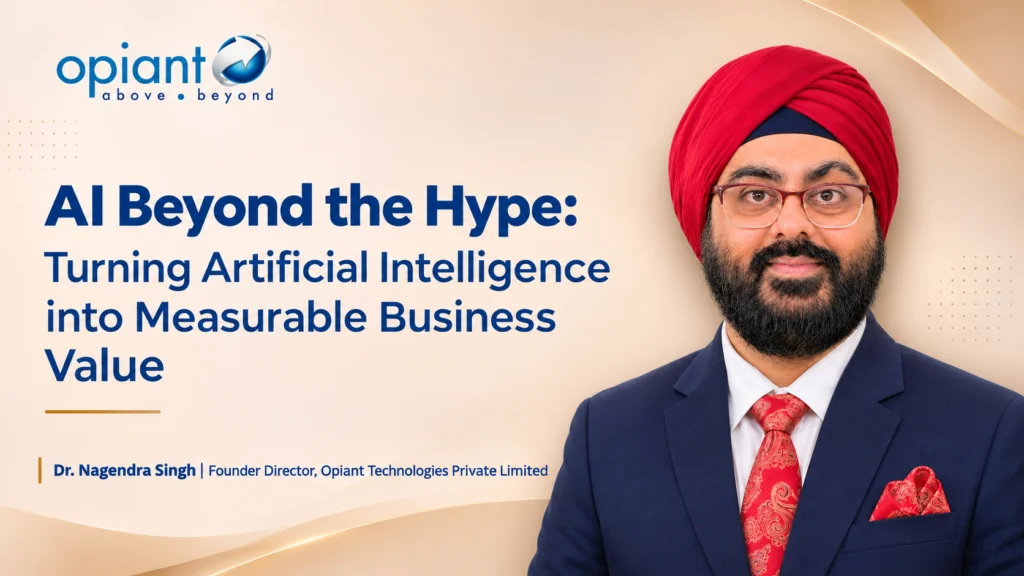
By Dr. Nagendra Singh | Founder Director, Opiant Technologies Private Limited
Artificial Intelligence has crossed a critical threshold. It is no longer a technology discussed only by innovation teams or technology enthusiasts, it is now a boardroom conversation.
CEOs are asking bigger questions: Where should we invest in AI? How do we measure the return? How do we integrate AI into existing operations? And how do we ensure that technology creates sustainable competitive advantage rather than becoming another expensive experiment?
The answer is not simply to adopt more AI.
The real opportunity is to build businesses that know how to turn intelligence into action.
“The winners of the AI era will not necessarily be those with the most AI tools. They will be those who embed intelligence into the right decisions, processes and customer experiences.”
From AI Experimentation to Enterprise Transformation
Over the past few years, organizations have experimented rapidly with generative AI, automation and machine learning. These experiments have demonstrated what is possible, but experimentation alone does not create transformation.
The next phase is about moving from isolated AI pilots to enterprise-wide business impact.
That starts with a simple principle: business outcomes must come before technology choices.
Instead of asking, “Where can we use AI?”, leadership teams should ask, “Which business challenges can AI help us solve better, faster or more intelligently?”
The opportunities can range from reducing operational costs and accelerating decision-making to improving customer experience, forecasting demand, supporting employees and creating entirely new revenue streams.
When AI is connected to measurable objectives, it stops being a technology initiative and becomes a business strategy.
The Rise of Intelligent Enterprises
The next evolution of enterprise AI is moving beyond content generation.
AI-powered systems are increasingly capable of understanding information, reasoning across data, recommending actions and supporting multi-step workflows. This evolution is creating the foundation for what can be described as the intelligent enterprise.
Imagine a business where customer requests can be understood and routed automatically, operational data can generate real-time insights, employees can access relevant information instantly, and routine decisions can be supported by intelligent systems.
This is where AI agents and agentic systems can become particularly powerful.
But the objective should not be technology for technology’s sake.
The goal is to give people greater leverage.
When AI handles repetitive and information-intensive work, employees can focus more on creativity, relationships, problem-solving and strategic thinking.
Data: The Engine Behind Intelligent Decisions
There is one fundamental truth that every AI strategy must recognize: AI is only as effective as the data and systems supporting it.
Many enterprises operate with data distributed across applications, databases, documents, cloud environments and legacy platforms. The challenge is not always a lack of data, it is the inability to connect, understand and act upon it effectively.
This makes data modernization, integration, governance and analytics critical components of an AI strategy.
The real journey is:
Data → Insight → Decision → Action → Outcome
The organizations that master this cycle will be better positioned to respond to market changes, understand customers and make faster, evidence-based decisions.
“AI without a strong data foundation can produce impressive demonstrations. AI combined with trusted data can produce transformative businesses.”
ROI Must Be Part of the AI Conversation
One of the most important responsibilities of leadership is to move the AI conversation from excitement to economics.
Every major AI initiative should have a clear definition of success.
Is the organization reducing processing time? Lowering operating costs? Increasing employee productivity? Improving customer retention? Reducing errors? Accelerating sales? Improving forecasting accuracy?
These outcomes can and should be measured.
AI investments should therefore be evaluated with the same discipline applied to other strategic investments.
What problem did we solve? What changed? How much did it improve? And what value did it create?
This shift in mindset separates meaningful AI transformation from technology experimentation.
Responsible AI Is a Business Imperative
As AI becomes more deeply integrated into business operations, trust becomes equally important.
Security, privacy, data governance, transparency and human oversight need to be designed into AI initiatives from the beginning.
Organizations must understand not only what an AI system can do, but also where human judgment remains essential.
The future will not be defined by humans versus machines.
It will be defined by organizations that know how to make humans and intelligent technology work better together.
The CEO’s AI Agenda
AI transformation ultimately requires leadership not just technology.
CEOs have an important role in creating the environment in which innovation can happen responsibly. That means encouraging experimentation, identifying high-value opportunities, breaking down the traditional separation between business and technology teams, and establishing clear measures of success.
The organizations that gain a lasting advantage will not necessarily be the ones that deploy AI fastest.
They will be the ones that deploy it with purpose.
At Opiant, we see the future of enterprise technology at the intersection of AI and agentic systems, data analytics, cloud engineering, software development and digital transformation. The opportunity is to bring these capabilities together to solve real business challenges and create intelligent, scalable and measurable solutions.
The AI revolution is no longer approaching.
It is already here.
The question for every CEO is no longer “Should we adopt AI?”
It is:
“How intelligently can we turn AI into business value?”
That is where the next generation of competitive advantage will be created.

Khushboo Singh
Senior Editor, Interviews & Profiles · CEO Review Magazine
Khushboo Singh is a business journalist at CEO Review Magazine, covering leadership strategy, corporate governance, and executive decision-making. With 5 Years of experience writing on C-suite priorities and organizational transformation, Khushboo's work focuses on translating complex business strategy into actionable insights for founders and executives. Expertise: Leadership, Corporate Strategy, Organizational Change