Leading with Purpose: How Rishabh Gupta Is Redefining Healthcare Delivery in India
In a sector often defined by infrastructure and clinical metrics, Rishabh Gupta is building what matters most - trust.. As Managing Director of ShardaCare-Healthcity, he represents a new generation of healthcare leaders who are rethinking what a hospital…
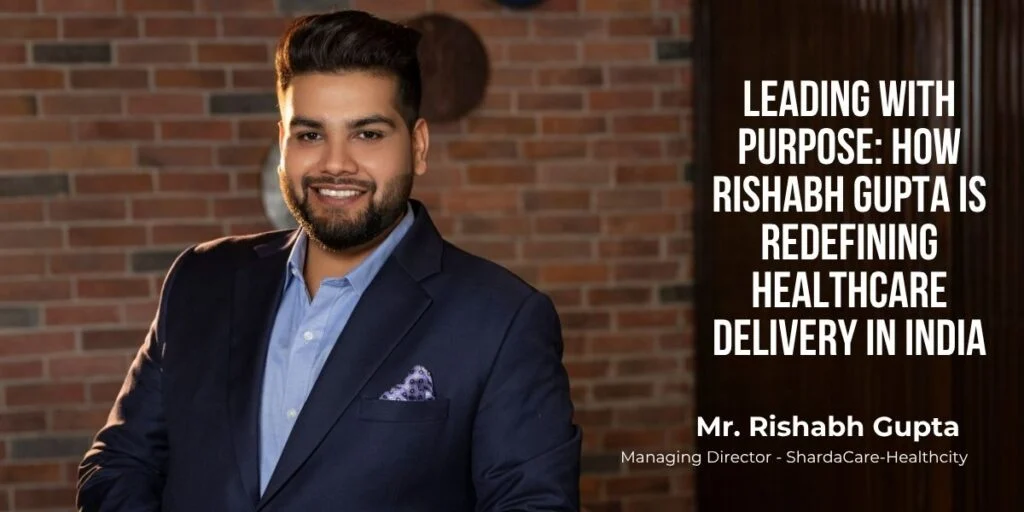
In a sector often defined by infrastructure and clinical metrics, Rishabh Gupta is building what matters most – trust..
As Managing Director of ShardaCare-Healthcity, he represents a new generation of healthcare leaders who are rethinking what a hospital should deliver beyond treatment. His approach is not centered only on expansion or technology adoption, but on designing a system where clinical excellence, operational discipline, and patient experience work in sync.
He doesn’t see healthcare as a conventional service industry. For him, it is a long-term responsibility, one that sits at the intersection of access, outcomes, and human dignity.
That thinking is rooted in his early training. A graduate of the Swiss Hotel Management School, he began his career understanding service from a hospitality lens, where consistency, responsiveness, and experience are non-negotiable. Instead of treating that background as separate from healthcare, he brought it into the core of hospital operations.
The result is visible in how ShardaCare-Healthcity has evolved.
Today, it stands as one of North India’s fastest emerging healthcare institutions, with growing depth across specialties and a clear focus on high-acuity care. The hospital is home to one of the region’s largest bone marrow transplant (BMT) programs and has built one of the country’s more extensive emergency and trauma care infrastructures, capabilities that reflect not just scale, but intent.
Over the past few years, the institution has expanded not just in size but in capability strengthening key specialties, building multidisciplinary teams, and investing in infrastructure that supports complex care. But he is clear that growth, in itself, is not the milestone.
“What matters is whether that growth translates into better access and better outcomes,” he says.
That lens has shaped several decisions, from building structured international patient services to improving pre-treatment planning and post-discharge continuity. Instead of fragmented care, the focus has been on creating a more coordinated system where patients don’t have to navigate complexity on their own.
He also believes that Indian healthcare is at an inflection point.

For decades, the system has been largely reactive, designed to treat illness rather than anticipate it. He is pushing for a more integrated model that connects prevention, early diagnosis, intervention, and long-term management. Under his leadership, the hospital has expanded its work in preventive health, corporate wellness programs, and community outreach, areas often overlooked in traditional hospital strategies.
“Technology is redefining the way healthcare is delivered,” says Rishabh. “When integrated thoughtfully, it empowers clinicians, improves outcomes, and creates a more connected healthcare experience for patients. Our focus is on embracing innovation that adds real value and helps us deliver care that is more accessible, efficient, and future-ready.”
That balance between innovation and empathy is a recurring theme in his leadership style.
Accessibility is another area where his approach stands out. While hospitals often remain concentrated in urban pockets, he sees expansion not just as a business decision, but as a necessity. Through outreach initiatives, partnerships, and participation in government-backed schemes, the focus has been on extending care to patients who would otherwise struggle to access it.
He is particularly clear on one point: geography or affordability should not dictate the quality of care a patient receives.
Internally, much of this translates into how teams are built and managed. He places strong emphasis on clinical autonomy, cross-specialty collaboration, and continuous learning, recognizing that outcomes are ultimately driven by people, not processes alone.
Also Read: Niveshan Technologies India Pvt. Ltd.: Energy of a young team, Wisdom of veterans
Related Reading:

Khushboo Singh
Senior Editor, Interviews & Profiles · CEO Review Magazine
Khushboo Singh is a business journalist at CEO Review Magazine, covering leadership strategy, corporate governance, and executive decision-making. With 5 Years of experience writing on C-suite priorities and organizational transformation, Khushboo's work focuses on translating complex business strategy into actionable insights for founders and executives. Expertise: Leadership, Corporate Strategy, Organizational Change