India’s Creative Economy Needs a New Education Model
India’s Creative Economy Needs a New Education Model — Here’s What That Looks Like What if education was not about what you learn, but about what you can create? India is at a critical inflection point. With over…
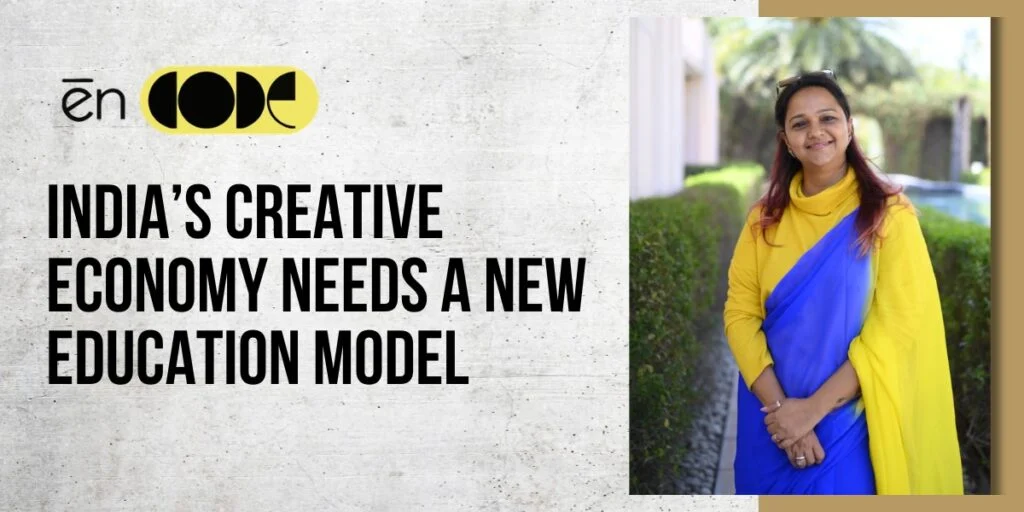
India’s Creative Economy Needs a New Education Model — Here’s What That Looks Like
What if education was not about what you learn, but about what you can create?
India is at a critical inflection point. With over 38-40 million students enrolled in higher education (as per AISHE data) and millions graduating every year, the country has one of the largest talent pipelines in the world. Yet, multiple reports from NASSCOM and World Economic Forum point to a consistent reality: only 45-50% of graduates are considered employable, and in high-growth digital and creative roles, this number is often significantly lower.
The gap becomes even more critical when viewed alongside India’s economic ambition. The country’s digital economy is expected to reach $1 trillion by 2030, according to McKinsey & Company, while the creator economy in India is already valued at over $20-25 billion and growing rapidly, as highlighted by Boston Consulting Group.
At the same time, the global Orange Economy driven by creativity, culture, and digital experiences contributes over $2.25 trillion annually and nearly 3% of global GDP, as per UNESCO.
India has both the demographic advantage and the market opportunity to lead this shift. But its education system is still built for a different era.
The Core Gap: Learning vs Capability
Traditional education systems are structured around inputs:
Curriculum completion
Standardized exams
Theoretical knowledge
Industry, however, hires based on outputs:
Problem-solving ability
Creativity and adaptability
Communication and collaboration
Real-world experience
This mismatch is reflected in hiring trends. According to LinkedIn insights, skills-based hiring has increased by over 20% in recent years, with employers prioritizing demonstrable capability over degrees especially in roles related to design, product, content, and digital innovation.
A New Approach: Outcome-Led, AI-Powered Learning
Addressing this gap requires more than incremental change. It requires rethinking how learning is designed, delivered, and measured. This is where CODE EDU (Centre for Originality, Design & Expression) positions itself as an AI-powered creative learning network built for the new economy.
Its platform, enCODE, introduces a phygital model that combines:
Studio-based, hands-on learning
AI-driven personalized pathways
Industry mentorship and live projects
Instead of a one-size-fits-all curriculum, learners move through adaptive journeys where AI aligns their progress with real-time market needs and evolving job roles.
From Marks to Measurable Outcomes
One of the most significant shifts in this model is evaluation. Rather than focusing on exams, enCODE uses a 360-degree Creative Outcome Rubric to assess:
Creativity and innovation
Critical thinking
Communication and collaboration
Leadership and problem-solving
Employability readiness
This aligns directly with what employers are looking for in an AI-augmented workforce.
Portfolio Over Degree: A Structural Shift
A defining feature of the platform is its portfolio-first approach. Learners don’t just complete courses-they build a body of work which includes –
Design projects
Case-based problem solving
Interdisciplinary collaborations
Industry-led assignments
Each learner is mapped to 500+ job roles, allowing them to understand career pathways and align their skill development accordingly.
For employers, this changes the hiring equation from evaluating resumes to assessing real capability.
A Real-World Use Case
Consider a second-year undergraduate student from a Tier-2 city with an interest in design and digital media.
In a traditional system, the student would:
Study theory-heavy subjects
Graduate with limited practical exposure
Struggle to demonstrate skills during hiring
Within the enCODE ecosystem, the same student:
Works on live design briefs and industry challenges
Builds a portfolio across multiple domains (graphics, UI/UX, content)
Receives mentorship from practitioners
Gets mapped to roles such as visual designer, content strategist, or digital product associate
By the time they graduate, they don’t just hold a degree-they have proof of work, role clarity, and market-relevant skills.
Democratizing Access to Cognitive Education
One of the biggest barriers in creative education has been access often limited to metro cities and premium institutions. CODE EDU addresses this through a low-cost, AI-powered hybrid model, enabling:
Scalable digital access
Localized studio experiences
A connected ecosystem of institutions, mentors, and industry
This is particularly important in India, where over 65% of the population resides outside Tier-1 cities, representing a massive untapped talent base.
Why This Matters Now
India’s next phase of growth will not come from replication, but from innovation. By 2027, it is estimated that over 50% of the workforce will require reskilling or upskilling, as highlighted in reports by World Economic Forum.
At the same time, AI is automating routine tasks while increasing the value of uniquely human skills such as creativity, systems thinking, and collaboration. Education systems that fail to adapt risk producing graduates for jobs that no longer exist.
The Road Ahead
The opportunity is not just to improve education, but to redesign it for the future of work. If scaled effectively, models like enCODE can:
Improve employability outcomes at scale
Enable industry-ready talent pipelines
Unlock value from India’s demographic dividend
Position India as a leader in the global creative economy
The Future of Education Is Outcome-Led
The question is no longer whether education needs to change.
It is whether it can change fast enough.
👉 For learners, institutions, and industry professionals looking to be part of this transformation, the opportunity is now. Explore the ecosystem and be part of the future: https://encode.codeedu.co/
GET IN TOUCH:
Website – https://codeedu.co/
Insta – https://www.instagram.com/codeeduofficial/
LinkedIn – https://www.linkedin.com/company/code-edu-official/
FB – https://www.facebook.com/Codeeduservices

Chirag Thakur
Editor, Business News · CEO Review Magazine
Chirag Thakur covers business news for CEO Review Magazine, along with markets, technology and industry explainers and the magazine's Top 10 rankings of companies and leaders.