Baroda BNP Paribas Mutual Fund Names Madhu Nair as CEO
Mumbai - Baroda BNP Paribas Asset Management India has announced the appointment of Madhu Nair as its Chief Executive Officer. He will take over from Sanjay Kumar Grover who has led the company during its growth phase. Nair…
Mumbai –
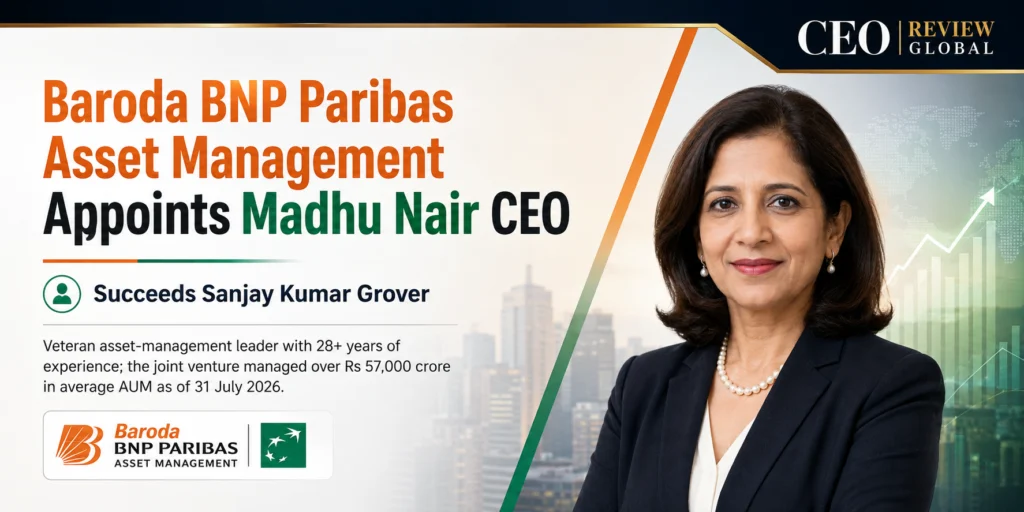
Baroda BNP Paribas Asset Management India has announced the appointment of Madhu Nair as its Chief Executive Officer. He will take over from Sanjay Kumar Grover who has led the company during its growth phase.
Nair has over 28 years of experience in asset management. Prior to joining Baroda BNP Paribas Asset Management India, he was serving as the Chief Executive Officer of Union Mutual Fund. He has also worked with leading firms such as HSBC, Invesco and Kotak in senior leadership roles. During his stint, he has experience in asset management, distribution channels and the retail investor space in India.
Bank of Baroda and BNP Paribas Asset Management Asia have a joint venture in the fund house. As of 31 July 20 26, it had over Rs 57,000 crore in average assets under management.
Indian asset management at an inflection point
Systematic plans have drawn first time investors by the millions into the market. Retail investors today span well beyond the metros. Digital distribution has reduced friction and cost of buying a mutual fund to almost zero.
Monthly SIP flows are now one of the most monitored metrics in Indian finance. They’ve given the industry a foundation of base inflows that was unheard of 10 years ago. These stable flows change how you can plan for the future. You don’t need to chase every market cycle. And investors will reward you for consistency of performance/service, over flashier campaign style asset gathering.
Where competition bites
But competition has also increased. The biggest houses have genuine scale advantages when it comes to brand recall, distributor economics and absorption of cost. Passive funds continue to take share and squeeze fees. New entrants have come in with licences and the explicit goal of upending old distribution economics.
For the mid cap firm, the question is increasingly where to play, not whether to play everywhere. That typically translates to picking a few categories to win, backing them appropriately, and resisting temptation to launch across the whole shelf.
Why Nair suits the mandate
His journey offers an answer. HSBC, Invesco and Kotak gave him a ringside view of how global asset managers function in India as also of deep bank-linked domestic institutions — two distinct models that approach distribution very differently.
Managing Union Mutual Fund provided him firsthand experience of running a bank affiliated outfit that has to expand share from a middle-sized base. That is something similar to what he inherits.
Quick facts
- Role: Chief Executive Officer, Baroda BNP Paribas Asset Management India
- Announced: August 2026
- Succeeds: Sanjay Kumar Grover
- Previously: Chief Executive Officer, Union Mutual Fund
- Earlier roles: HSBC, Invesco, Kotak
- Experience: More than 28 years
- Average assets under management: More than Rs 57,000 crore as of 31 July 2026
- Structure: Joint venture between Bank of Baroda and BNP Paribas Asset Management Asia
Turning bank reach into assets
At the heart of the proposal is a partnership with the Bank of Baroda. Its branch network connects to savers across vast geography, stretching to markets where mutual fund penetration remains well below potential. Turning that reach into assets under management is easier said than done. It requires continued investment in distributor enablement, designing products for first time investors and delivering consistent fund performance because if a branch relationship manager doesn’t understand or trust something he won’t recommend it. BNP Paribas brings to the partnership global investment infrastructure, risk management practices and product expertise from other markets. Blending these two sources of competitive advantage into a single commercial strategy is at the heart of what the chief executive has been charged to deliver.
What to watch next
Grover departs having left Nair a platform of substantial meaning. Metrics to watch that will indicate if Nair expands on Grover’s legacy are the percentage of assets that come from retail vs institutional investors, growth in SIP accounts and distribution of assets across smaller cities versus metropolitan India. The broad tailwind still persists. Indian households are continuing to move their savings from physical assets and conventional bank deposits into market correlated products, and that structural shift is far from over. The competitive battle will be fought over who gains market share of that flow.
Isha Sharma
Editor, Executive Appointments · CEO Review Magazine
Isha Sharma covers executive appointments and leadership changes for CEO Review Magazine, reporting on new CEO, CXO and board-level moves at Indian and global companies and what they mean for the businesses involved.