RBI Hikes Repo Rate by 25 bps to 5.5%, First Increase Since 2023
RBI raises repo rate 25 bps to 5.5%, shifts stance to calibrated tightening and lifts FY27 inflation forecast to 5.2%.
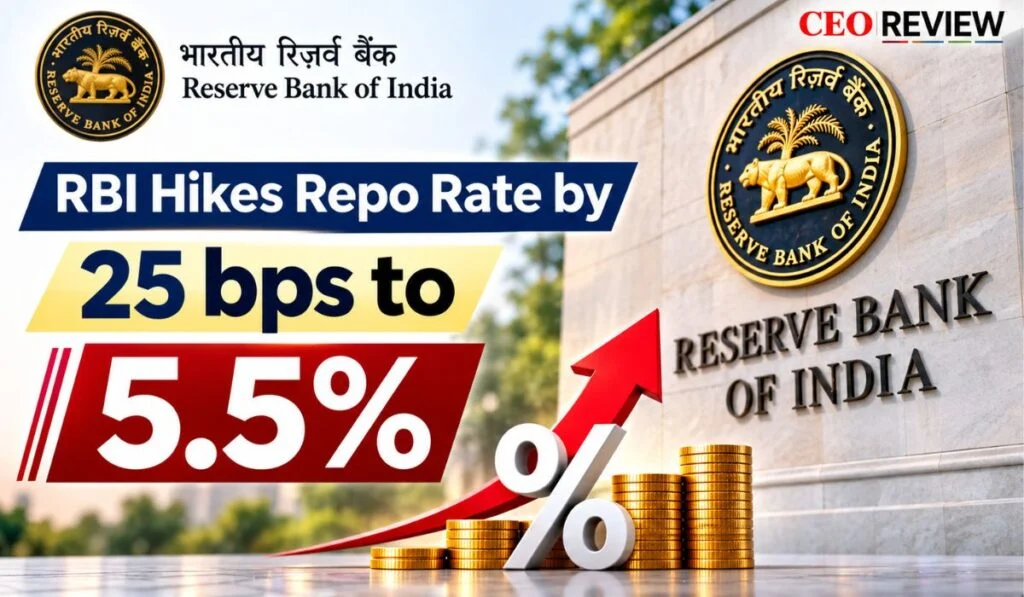
The Reserve Bank of India (RBI) raised the policy repo rate by 25 basis points to 5.50% on Wednesday, October 7, its first rate increase since February 2023. The six-member Monetary Policy Committee (MPC), headed by Governor Sanjay Malhotra, voted unanimously for the hike and, by a 4-2 majority, changed the policy stance from neutral to “calibrated tightening”.
Following the decision, the Standing Deposit Facility (SDF) rate was adjusted to 5.25%, while the Marginal Standing Facility (MSF) rate and the Bank Rate were raised to 5.75%. The repo rate had been held at 5.25% for the previous four reviews, after the central bank cut rates by a cumulative 125 basis points in 2025.
Inflation forecast raised
The RBI raised its consumer price index (CPI) inflation projection for FY27 to 5.2%. It expects inflation at 4.9% in the July–September quarter, rising to 6% in the October–December quarter before easing to 5.7% in the January–March quarter.
Retail inflation rose to 4.8% in August from 4.5% in July, driven mainly by food and fuel prices. Core inflation climbed to 4.2%. The central bank flagged elevated crude oil prices, higher food prices, rising global bond yields and pressure on the rupee as key risks. It also cited the re-escalation of the West Asia conflict in September and a weak monsoon linked to a strong El Niño, which could affect the rabi season.
At the same time, the RBI raised its real GDP growth forecast for FY27 to 7.1% from 6.7% projected in August. Growth is projected at 7.2% in the second quarter, 6.9% in the third and 6.8% in the fourth. The economy grew 7.8% in the April–June quarter.
Rate cuts off the table
Malhotra signalled that the easing cycle is over for now. “The policy action ahead can only be a rate hike or a pause,” he said in his policy address. He added that economic activity remained strong and broad-based, with resilient private consumption and strong fixed investment.
The duration and extent of the tightening cycle will depend on incoming data on growth and inflation, especially underlying price pressures and any second-round effects of the supply shock, according to the MPC’s statement.
Markets and analysts
The hike was largely anticipated. Eight of 10 respondents in a Business Standard poll ahead of the meeting had forecast a 25-basis-point increase. Goldman Sachs had projected hikes at both the October and December meetings.
Equity benchmarks slipped after the announcement. Around midday, the Sensex was down 186 points, or 0.25%, at 72,878, while the Nifty50 fell 0.41% to 22,683. Rate-sensitive auto and real estate stocks declined, while banking shares gained.
For companies, the decision marks a turn in borrowing costs after more than a year of easing. Loans linked to the external benchmark repo rate are set to reset higher, raising EMIs for home and auto borrowers. Corporate treasuries will now watch September inflation data and the MPC’s next review in December for signs of further tightening.

Khushboo Singh
Senior Editor, Interviews & Profiles · CEO Review Magazine
Khushboo Singh is a business journalist at CEO Review Magazine, covering leadership strategy, corporate governance, and executive decision-making. With 5 Years of experience writing on C-suite priorities and organizational transformation, Khushboo's work focuses on translating complex business strategy into actionable insights for founders and executives. Expertise: Leadership, Corporate Strategy, Organizational Change