AI First. Code Second. Nitya Bathula’s Blueprint for the Future of Software
In an era where artificial intelligence is redefining how industries think, build, and scale, Nitya Bathula stands at the intersection of deep engineering and bold platform thinking. As the Chief Executive Officer of D3E Studio, she is leading one of India’s…
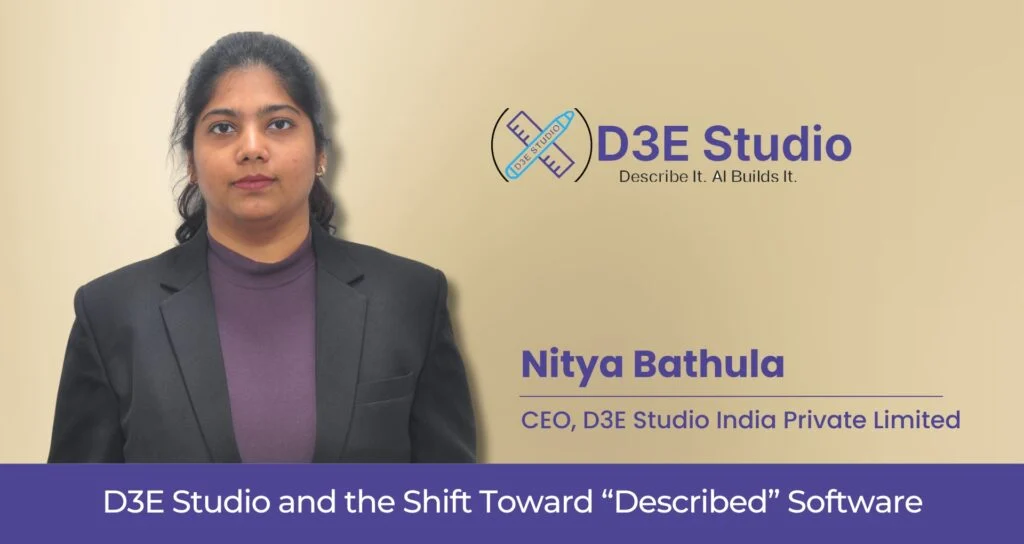
 In an era where artificial intelligence is redefining how industries think, build, and scale, Nitya
Bathula stands at the intersection of deep engineering and bold platform thinking. As the Chief
Executive Officer of D3E Studio, she is leading one of India’s most ambitious efforts to
fundamentally rethink how software itself is created.
Based in Hyderabad, Telangana, Nitya represents a new generation of Indian women
technology leaders—builders of original intellectual property, architects of platforms, and CEOs
shaping global products from India.
Her journey spans continents and roles: from early years as a front-end and full-stack developer,
to serving as an IT Professional with the State of Nevada in the United States, and finally to
returning to India to lead the engineering and strategic vision of D3E Studio India Private
Limited. Each chapter has contributed to her defining belief: that the future of software lies not
in writing more code, but in describing systems more intelligently.
From Developer to Platform CEO
Nitya’s foundation is deeply technical. She holds a Master’s degree in Computer Science from
Southern University and A&M College (USA) and has worked across frontend, full-stack, and
enterprise IT environments. Her experience spans large government systems in the US and high-
scale engineering teams in India—giving her a rare, end-to-end view of how software is built,
deployed, and maintained in the real world.
Rather than continuing along a conventional global technology career path, Nitya made a
decisive choice: to return to India and build something original.
That decision led to D3E Studio—not as a services company, but as a platform-first, IP-driven
Product organization aims to reimagine the fundamentals of software creation.
D3E Studio and the Shift Toward “Described” Software
For decades, software development has been defined by complexity. Even simple applications
often require thousands of lines of code and coordination across frontend, backend, and database
teams, and parallel builds for web, mobile, and enterprise platforms. The result has been slow
development cycles, fragmented workflows, and rising costs.
As artificial intelligence reshapes every industry, a critical question emerges:
Does software still need to be built this way?
D3E Studio’s answer is a decisive no.
An AI-powered software creation platform, D3E Studio allows users to build everything from
static websites to complex enterprise applications using natural language descriptions. Instead
Instead of starting with code, users begin by describing what they want the system to do. The platform
then designs, structures, and constructs the application.
At its core, D3E Studio brings together three powerful elements:
- Artificial intelligence
- A live visual canvas
- A new declarative programming language called .d3e
Together, these elements form a unified approach to software creation—one that moves beyond code generation to a system-level understanding.
From Intent to Implementation
Most AI tools in software development today operate at a narrow level. They generate snippets
of code, suggest refactoring, or explain syntax. While helpful, they still assume humans must
design architecture, define data models, and wire systems together.
D3E Studio takes a fundamentally different approach.
When a user enters a prompt such as “Create a CRM with user login, customer management,
and reporting”—the platform does not merely mock up screens. It reasons through the entire
system. It designs data models, defines relationships, builds backend services, creates APIs,
wires queries, generates user interfaces, and implements business logic.
In essence, the user specifies intent, and the platform determines structure.
The system also supports static website creation—currently using React and TypeScript.
Marketing sites, landing pages, documentation portals, and portfolios can all be generated via
prompts. These are not rigid templates, but complete, deployable codebases.
Crucially, these static sites are not dead ends. Because they are built on the same underlying
system, they can evolve into full dynamic applications without being rebuilt from scratch.
A Visual Canvas That Reflects Reality
One of D3E Studio’s most distinctive innovations is its visual canvas.
Unlike conventional drag-and-drop builders that produce disconnected mockups, D3E’s canvas
is a live representation of the real application. Users can assemble screens, rearrange layouts,
Configure properties, define conditions, attach behaviors, and preview changes instantly.
Every interaction on the canvas directly corresponds to definitions in the .d3e language. There is
no separation between design and development modes—both technical and non-technical users
work on the same underlying system.
This approach dramatically lowers the barrier to entry without sacrificing transparency or control
for experienced developers.
The .d3e Language: Describing What Software Is
At the foundation of the platform is the .d3e declarative language, designed to describe what an
application is, rather than how it must be implemented in a specific framework.
Using .d3e, teams define the following:
- Pages and navigation flows
- Reusable widgets and components
- Themes and styling rules
- Data models and relationships
- Queries and state
- Events and business logicA single .d3e file becomes the source of truth for the entire application. From this definition,
D3E Studio generates frontend interfaces, backend services, APIs, and database schemas.
Because the language is platform-neutral, applications are not locked into one technology stack.
While React and TypeScript are used today, the same .d3e specification can be compiled into
other stacks in the future.
Engineering for Maintainability at Scale
One of the major concerns around AI-generated software is maintainability. Poorly structured
AI-generated code can quickly become brittle, opaque, and difficult to evolve.
D3E Studio addresses this by enforcing clear architectural discipline.
Applications follow structured principles: pages act as navigation units, widgets serve as
reusable building blocks, data access is declarative, state is explicit, business logic lives in event
handlers, and themes govern visual consistency.
This ensures that applications created on the platform are not experimental prototypes.
but production-grade systemsdesigned to scale.
Building a Global Platform from India
Under Nitya Bathula’s leadership, D3E Studio’s India engineering team has grown to over 120
engineers, primarily based in Hyderabad. This team is responsible for designing the .d3e
language, building the AI reasoning engine, developing the visual canvas, and implementing
enterprise workflows.
While D3E maintains a presence in the United States, India is the company’s engineering and
innovation core. The platform is designed to generate complex systems, such as ERP platforms.
HR tools, accounting software, inventory management systems, and large enterprise applications.
Building such a platform requires long-term vision, consistency, and depth—qualities that define
both the company culture and Nitya’s leadership style.
From Services to Ownership
Nitya Bathula’s work reflects a larger transformation underway in India’s technology ecosystem.
For decades, India was globally recognized as a services powerhouse. Today, leaders like Nitya
are pushing the ecosystem toward platform ownership and intellectual property creation.
D3E Studio is a tangible example of that shift—demonstrating that advanced AI platforms, new
programming languages, and enterprise-grade software engines can be conceived, built, and
scaled from India.
The Future of Software
D3E Studio points toward a future where software is no longer written line by line,
but described system by system. Where intent replaces syntax, and intelligence replaces
repetition.
In simple terms: users describe what they want, and the system builds it.
As artificial intelligence continues to reshape industries, platforms like D3E Studio signal a
profound shift in how software will be created—and who will lead that change.
Increasingly, that future is being shaped by women leaders, original thinkers, and platform
builders from India.
And at the center of this transformation stands Nitya Bathula.

Khushboo Singh
Senior Editor, Interviews & Profiles · CEO Review Magazine
Khushboo Singh is a business journalist at CEO Review Magazine, covering leadership strategy, corporate governance, and executive decision-making. With 5 Years of experience writing on C-suite priorities and organizational transformation, Khushboo's work focuses on translating complex business strategy into actionable insights for founders and executives. Expertise: Leadership, Corporate Strategy, Organizational Change