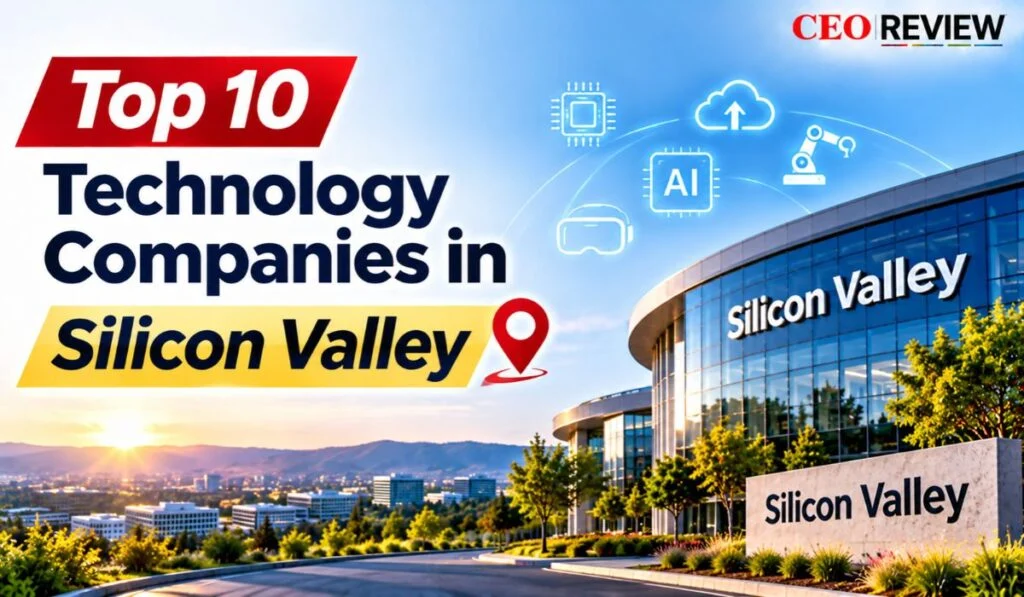
Top 10 Technology Companies in Silicon Valley 2026
Apple, Alphabet and Nvidia lead the top 10 technology companies in Silicon Valley for 2026, ranked by latest annual revenue, with Meta, Broadcom, Cisco, HP, Intel, Netflix and Supermicro.
Everyone thought Silicon Valley was on its way out. Remote work, a high cost of living and a wave of headquarters moves to Texas and beyond had people predicting its demise just a few years ago.
Recent numbers say otherwise. Nvidia generated $96.2 billion in revenue in the quarter that ended July 26, 2026. That’s more than twice what it made a year earlier. Its neighbors are spending at a pace few industries have ever seen, with Meta forecasting $130 billion to $145 billion of capital spending in 2026 as companies pour money into building out AI.
To keep this list fair, we ranked companies on one measure: the most recent full fiscal-year revenue each one had reported as of October 27, 2026. Only technology companies headquartered in Silicon Valley itself were included, from Menlo Park and Palo Alto down to San Jose and Los Gatos. Companies based in San Francisco, IT distributors and companies that have moved their headquarters out of California are not listed. This guide looks at the top 10 technology companies in Silicon Valley for 2026, what they do and who they suit best.
Also Read: Top 10 Data Science Companies in the USA
Why Silicon Valley Still Leads the Technology Industry
Silicon Valley companies dominate many layers of the AI stack, from chipmaking and networking to devices, cloud and consumer apps.
The AI Chip Supply Chain Runs Through Santa Clara and Palo Alto
Nvidia made $89.0 billion in data center revenue in a single quarter this year. Broadcom’s AI semiconductor revenue hit $16.7 billion in its fiscal third quarter, a 221% increase year over year. These are the companies feeding the world’s demand for AI compute.
Hyperscale Spending Keeps Growing
Alphabet poured $44.9 billion into property and equipment in the second quarter of 2026 alone. Local suppliers are feeling the effect of that kind of spending. Cisco, for one, took $9.3 billion in AI infrastructure orders from hyperscalers in fiscal 2026.
Consumer Platforms With Global Reach
Meta averaged 3.60 billion daily active people across its apps in June 2026. Netflix said it had more than 325 million paying subscribers at the start of the year. It’s hard to find another spot on the globe with that kind of consumer reach.
Old Names Are Reinventing Themselves
Intel, HP and Cisco have been around for decades, yet all three showed double-digit revenue growth in their latest reported quarters. They’re riding the AI wave, whether through AI PCs, advances in chipmaking or data center networking.
Top 10 Technology Companies in Silicon Valley at a Glance
| Rank | Name | Core segment | Key 2026 figure |
|---|---|---|---|
| 1 | Apple | Consumer devices and services | FY2025 revenue: $416 billion |
| 2 | Alphabet (Google) | Search, cloud, AI | 2025 revenue: $402.8 billion |
| 3 | Nvidia | AI chips and systems | FY2026 revenue: $215.9 billion |
| 4 | Meta Platforms | Social apps, AI | 2025 revenue: $201.0 billion |
| 5 | Broadcom | Semiconductors, infrastructure software | FY2025 revenue: $63.9 billion |
| 6 | Cisco | Networking, security | FY2026 revenue: $63.3 billion |
| 7 | HP Inc. | PCs, printing | FY2025 revenue: $55.3 billion |
| 8 | Intel | Processors, foundry | 2025 revenue: $52.9 billion |
| 9 | Netflix | Streaming entertainment | 2025 revenue: about $45.2 billion |
| 10 | Supermicro | AI servers, data center systems | FY2026 net sales: $39.1 billion |
Top 10 Technology Companies in Silicon Valley (2026)
Below is our list of the top 10 technology companies in Silicon Valley, based on each company’s latest reported fiscal-year revenue (all figures in US$).
1. Apple
Apple is based in Cupertino and was founded in 1976. It made $416 billion in revenue in fiscal 2025, which ended September 27, 2025, making it the highest-earning tech company in Silicon Valley. The iPhone is still its top product, along with the Mac, iPad and wearables. Its services business also hit an all-time revenue record.
Apple kept its momentum in 2026, growing June-quarter revenue 16% to $109.4 billion, its best June quarter ever. iPhone, Mac and Services all grew by double digits. Leadership changed too: John Ternus took over as CEO on September 1, 2026, and Tim Cook became executive chairman. At WWDC26, Apple unveiled its new AI-powered Siri.
Key Technology Solutions
✔ iPhone, Mac, iPad and Apple Watch
✔ Services including the App Store, iCloud and Apple Music
✔ On-device AI features and the new Siri
✔ Custom Apple silicon across its product lines
Best for: Consumers and enterprises that want a tightly integrated hardware, software and services ecosystem.
2. Alphabet (Google)
Alphabet, Google’s parent company, is based in Mountain View. Google was created in 1998. Alphabet made $402.8 billion in revenue in 2025, a close second to Apple. Search, YouTube and Android drive most of that, while Google Cloud and the Gemini models are growing fast.
Alphabet’s revenue grew 24% in the second quarter of 2026 to $119.8 billion. Google Cloud revenue rose 82% to $24.8 billion, and the Gemini app reached 950 million monthly active users. Gemini models were processing 22 billion API tokens per minute. Alphabet also spent $44.9 billion on property and equipment in the quarter, much of it on AI infrastructure. Sundar Pichai is CEO of both Google and Alphabet.
Key Technology Solutions
✔ Google Search, YouTube and Android
✔ Google Cloud infrastructure and AI services
✔ Gemini models and the Gemini app
✔ Google Workspace for businesses
Best for: Businesses that need cloud, AI models and digital advertising reach under one roof.
3. Nvidia
Nvidia was founded in 1993 and is based in Santa Clara. Co-founder Jensen Huang is still CEO. The company made $215.9 billion in revenue in fiscal 2026, which ended January 25, 2026, a 65% jump from the year before. Its GPUs, networking and software power much of the world’s AI training and inference.
Growth has sped up in 2026. Revenue for the second quarter of fiscal 2027, which ended July 26, 2026, came in at $96.2 billion, up 106% year over year. Of that, $89.0 billion came from the data center business. Nvidia guided to about $108 billion for the third quarter, assuming no data center compute revenue from China. Blackwell platforms drive current sales, and the Rubin platform is next.
Key Technology Solutions
✔ Blackwell and Blackwell Ultra AI platforms
✔ Vera Rubin, the next-generation platform
✔ NVLink and data center networking
✔ CUDA software and AI frameworks
Best for: Cloud providers, AI labs and enterprises building large-scale AI infrastructure.
4. Meta Platforms
Meta Platforms is based in Menlo Park and was founded in 2004. It owns Facebook, Instagram, WhatsApp and Messenger. Meta made $201.0 billion in revenue in 2025 and had 75,472 employees at the end of June 2026.
Meta grew revenue 28% to $60.8 billion in the second quarter of 2026, and its apps averaged 3.60 billion daily active people in June. It’s investing heavily in AI, with 2026 capital expenditures projected at $130 billion to $145 billion, much of it for data centers and computing power to train its models. That spending has weighed on free cash flow, and it’s worth watching.
Key Technology Solutions
✔ Facebook, Instagram, WhatsApp and Messenger
✔ AI-driven advertising tools for businesses
✔ Meta AI assistant and Llama models
✔ Reality Labs hardware and smart glasses
Best for: Brands and small businesses that want to reach billions of users through targeted advertising.
5. Broadcom
Broadcom is based in Palo Alto and is led by President and CEO Hock Tan. It made $63.9 billion in revenue in fiscal 2025, up 24% year over year. Broadcom designs semiconductors for networking, storage and wireless. It also sells infrastructure software, a business it expanded when it completed its $69 billion acquisition of VMware in November 2023.
Custom AI chips have made Broadcom one of the fastest-growing large companies in Silicon Valley. Revenue rose 86% to $29.6 billion in its fiscal third quarter of 2026, with AI semiconductors accounting for $16.7 billion, up 221% year over year. Hyperscalers use Broadcom for custom accelerators and for the networking switches that link their AI clusters.
Key Technology Solutions
✔ Custom AI accelerators for hyperscalers
✔ Ethernet switching and networking chips
✔ VMware private cloud software
✔ Storage, broadband and wireless semiconductors
Best for: Hyperscalers and large enterprises that need custom silicon and private cloud software.
6. Cisco
Cisco was founded in 1984 and is based in San Jose. Chuck Robbins is its chair and CEO. Revenue for fiscal 2026, which ended in July, rose 12% to $63.3 billion. Cisco makes the switches, routers, security and collaboration tools that companies use to run their networks.
AI has brought new growth to Cisco’s networking business. Fourth-quarter revenue rose 18% to $17.3 billion, and networking product orders were up 40%. Cisco took $9.3 billion in AI infrastructure orders from hyperscalers during the fiscal year and booked about $4 billion of AI infrastructure revenue. It expects that number to reach $7.5 billion in fiscal 2027. Management calls it a “networking supercycle.”
Key Technology Solutions
✔ Data center and campus switching and routing
✔ AI infrastructure networking for hyperscalers
✔ Security and observability platforms
✔ Webex collaboration tools
Best for: Enterprises and service providers modernizing their networks for AI workloads.
7. HP Inc.
HP Inc. got its start in the Palo Alto garage where Bill Hewlett and Dave Packard founded the company in 1939. It’s still based in Palo Alto. Net revenue for fiscal 2025 was $55.3 billion, up 3.2%. HP is one of the world’s biggest makers of PCs and printers.
Net revenue rose 12.5% to $15.7 billion in the third quarter of fiscal 2026, driven by premium products, workstations and AI PCs. HP is also going through a CEO change. Enrique Lores left in February 2026 to become CEO of PayPal, and board member Bruce Broussard is serving as interim CEO while the board searches for a permanent leader.
Key Technology Solutions
✔ AI PCs and Copilot+ PCs
✔ Workstations for designers and engineers
✔ Office and home printing
✔ Hybrid work devices and services
Best for: Businesses refreshing PC fleets and printing infrastructure.
8. Intel
Intel was founded in 1968 and is based in Santa Clara. It reported 2025 revenue of $52.9 billion, flat with the year before. Its Core and Xeon processors still power a large share of the world’s PCs and servers, and Intel Foundry is working to win outside customers for its chip manufacturing.
Under CEO Lip-Bu Tan, revenue rose 25% in the second quarter of 2026 to $16.1 billion, which Tan called Intel’s strongest revenue growth in more than fifteen years. Xeon 6+, Intel’s first server product built on Intel 18A, launched in the quarter. Some Core Ultra Series 3 processors, code-named Panther Lake, entered high-volume manufacturing using High NA EUV technology. Intel will report third-quarter results on October 29, 2026.
Key Technology Solutions
✔ Core Ultra processors for AI PCs
✔ Xeon server processors
✔ Intel Foundry and the 18A process
✔ Advanced packaging services
Best for: PC makers, server buyers and chip designers looking for U.S.-based manufacturing.
9. Netflix
Netflix is based in Los Gatos and had about 16,000 full-time employees at the end of 2025. Its 2025 revenue was about $45.2 billion. In January 2026, Netflix said it had more than 325 million paying subscribers. The service runs on its own technology for streaming, recommendations and advertising.
Netflix grew revenue 12% to $12.9 billion in the third quarter of 2026, and its operating margin rose to 34.6%. It projects 2026 revenue of $51.1 billion. Netflix now expects about $2.7 billion in ad revenue this year, down from an earlier estimate of about $3 billion, and plans to bring its ad tier to 15 more countries in 2027. Greg Peters and Ted Sarandos are co-CEOs.
Key Technology Solutions
✔ Global streaming platform
✔ Personalization and recommendation systems
✔ Ad-supported plan and in-house ad technology
✔ Live events and games
Best for: Advertisers and entertainment partners that want access to a global streaming audience.
10. Supermicro
Super Micro Computer, known as Supermicro, was started in 1993 in San Jose by Charles Liang, who still serves as president and CEO. It began as a motherboard maker and now builds servers, storage and complete AI data center systems. Preliminary, unaudited results show fiscal 2026 net sales of $39.1 billion for the year ended June 30, 2026, up from $22.0 billion a year earlier.
AI demand has made Supermicro one of the valley’s fastest growers. Net income rose to $2.2 billion in fiscal 2026, and the company projects fiscal 2027 net sales of $65 billion to $72 billion. Liang credits its Data Center Building Block Solutions (DCBBS) architecture with improving profitability. The board is also conducting an independent review of certain transactions related to export controls, which buyers and investors should keep an eye on.
Key Technology Solutions
✔ GPU-dense AI servers
✔ Data Center Building Block Solutions (DCBBS)
✔ Liquid-cooled rack systems
✔ Storage and edge servers
Best for: Cloud providers and enterprises that need AI server capacity quickly.
Coming in just outside the top 10 technology companies in Silicon Valley is AMD. Also based in Santa Clara, it reported record 2025 revenue of $34.6 billion.
How to Choose the Right Technology Partner in Silicon Valley
Whether you’re buying from, partnering with or investing in Silicon Valley tech companies, here are a few things to keep in mind.
Check the Financials Yourself
Every company on this list is publicly traded and files annual 10-K and quarterly 10-Q reports with the SEC. Check the latest filings on EDGAR for revenue trends and cash flow instead of relying on headlines.
Look at the AI Roadmap
Most of these companies are building AI into new products. Find out what a partner can deliver today and what’s still on the roadmap, such as next-generation chips.
Watch Leadership Changes
Apple and HP both changed CEOs in 2026. New leaders can shift priorities, pricing and product plans, so keep that in mind before you sign a long-term contract.
Consider Supply and Export Rules
U.S. export controls affect AI chip sales. Nvidia’s outlook assumes no data center compute revenue from China, and Supermicro’s board is reviewing export-control-related transactions. If your supply chain crosses borders, ask how these rules affect delivery.
Mind Ecosystem Lock-In
Platform lock-in is real. If you build your business around Apple’s hardware, Nvidia’s CUDA software or Broadcom’s VMware stack, it can be hard and costly to leave. Weigh long-term flexibility against short-term convenience.
Frequently Asked Questions About Technology Companies in Silicon Valley
What is the largest technology company in Silicon Valley by revenue?
Apple leads with $416 billion in fiscal 2025 revenue. Alphabet is a close second at $402.8 billion for 2025. Nvidia is growing much faster, though. Its $96.2 billion quarter that ended in July 2026 was only $13.2 billion behind Apple’s $109.4 billion June quarter.
Why aren’t Oracle, Salesforce or Qualcomm on the list?
Oracle moved its headquarters out of California, Salesforce is based in San Francisco and Qualcomm is based in San Diego. This list only counts companies headquartered in Silicon Valley itself.
How did you rank these Silicon Valley tech companies?
We used each company’s latest full fiscal-year revenue as reported by October 27, 2026. Fiscal years differ, so Cisco’s and Supermicro’s figures cover years ending in mid-2026, while Apple’s year ended in September 2025. No single company is best for everyone; it depends on what you need.
Which Silicon Valley cities have the most big tech headquarters?
On this list, Santa Clara (Nvidia, Intel), Palo Alto (Broadcom, HP) and San Jose (Cisco, Supermicro) each host two, while Cupertino, Mountain View, Menlo Park and Los Gatos host one each.
Conclusion
The top 10 technology companies in Silicon Valley in 2026 earned more than $1.5 trillion in combined revenue in their latest fiscal years. Apple and Alphabet still lead on size, but Nvidia, Broadcom and Supermicro are growing far faster on the back of AI demand.
For buyers and partners, the takeaway is simple. Check the filings, test the AI claims and watch who is running the company. Silicon Valley’s biggest names are changing fast, and the list may look different again by 2027.
Related Reading:

Chirag Thakur
Editor, Business News · CEO Review Magazine
Chirag Thakur covers business news for CEO Review Magazine, along with markets, technology and industry explainers and the magazine's Top 10 rankings of companies and leaders.