Top 10 Biggest US Banks by Assets 2026
JPMorgan Chase, Bank of America and Citigroup lead the top 10 biggest US banks by assets in 2026, ranked by total assets at September 30, 2026 from Q3 2026 earnings releases.
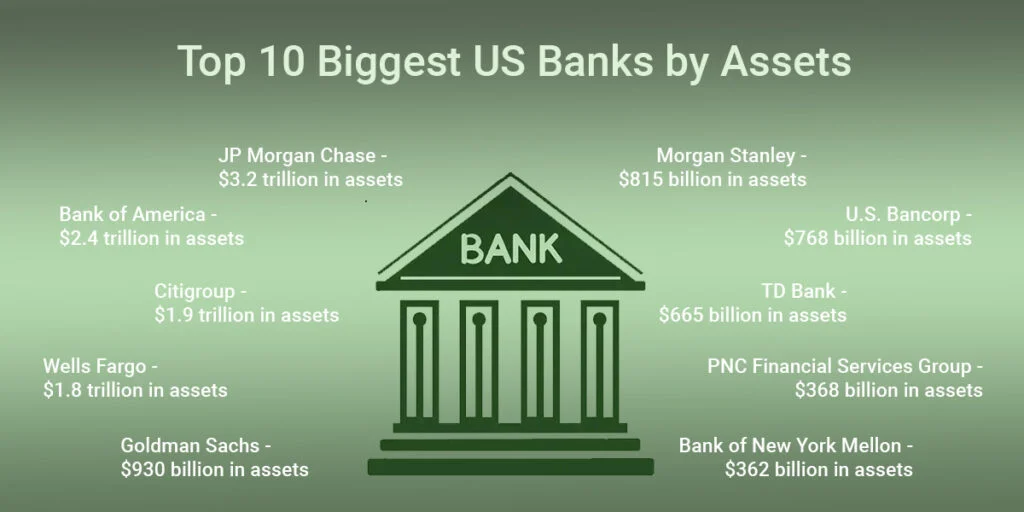
$5 trillion. That’s about how much money sits on the balance sheet of the largest bank in the US.
As of September 30, 2026, JPMorgan Chase had total assets of $5.09 trillion. Bank of America was second with $3.43 trillion and Citigroup third with $2.94 trillion. The 10 banks on this list have combined assets of just over $20 trillion. A large gap has formed at the top, and some recent M&A has reshuffled the bottom half of the list.
How we ranked them: we used the total consolidated assets of each bank holding company as of September 30, 2026, from each company’s third-quarter 2026 earnings release and financial supplement, published between October 13 and October 21, 2026. Amounts are in US dollars. The Federal Reserve’s Large Commercial Banks release lists individual bank charters rather than holding companies, so its totals will differ.
Also Read: Top 10 Banks in the UK 2026
Many of these banks serve millions of American households, while others focus more on businesses, governments and wealthy investors. This guide looks at the top 10 biggest US banks by assets for 2026, with an overview of what each bank does best and who it suits.
Why the Size of a Bank Still Matters
Size doesn’t mean everything in banking, but it does shape how a bank is regulated, how far it reaches and what it can offer.
Stricter Rules for the Largest Banks
The largest US banks are subject to higher capital requirements. In the Financial Stability Board’s 2025 list of global systemically important banks, JPMorgan Chase was placed in the highest bucket, which requires an extra 2.5% Common Equity Tier 1 buffer. Bank of America and Citigroup are in bucket 3.
Reach Across the Country
More size usually means more branches. Chase had 5,164 branches and Bank of America had 3,531 financial centers at the end of September 2026. If you want access to a local branch, that kind of footprint helps.
Capacity to Lend and Invest
A bigger balance sheet lets a bank take on larger business deals and carry a bigger loan book. It also gives the bank room to keep investing in its business and technology, and to absorb a bad quarter without changing course.
The Same Deposit Protection
Size does not matter when it comes to FDIC insurance. Each depositor is insured up to $250,000 per FDIC-insured bank, for each account ownership category. Whether it’s a massive bank or a small community bank, the coverage is the same.
Top 10 Biggest US Banks by Assets at a Glance
| Rank | Bank | Core segment | Total assets (Sept 30, 2026) |
|---|---|---|---|
| 1 | JPMorgan Chase | Universal bank: consumer, corporate, investment banking | $5.09 trillion |
| 2 | Bank of America | Consumer banking, Merrill wealth management, global markets | $3.43 trillion |
| 3 | Citigroup | Global corporate services, markets, cards | $2.94 trillion |
| 4 | Wells Fargo | Consumer, commercial and corporate banking | $2.25 trillion |
| 5 | Goldman Sachs | Investment banking, trading, asset and wealth management | $2.18 trillion |
| 6 | Morgan Stanley | Wealth management, investment banking, trading | $1.69 trillion |
| 7 | U.S. Bancorp | Regional consumer and business banking, payments | $703.0 billion |
| 8 | Capital One | Credit cards, consumer banking, payment networks | $672.9 billion |
| 9 | PNC Financial Services | Regional retail and corporate banking | $627.8 billion |
| 10 | Truist Financial | Regional banking in the Southeast and Mid-Atlantic | $554 billion |
Top 10 Biggest US Banks by Assets (2026)
Below are the top 10 biggest US banks by assets, ranked by holding-company total assets as of September 30, 2026.
1. JPMorgan Chase
With total assets of $5.09 trillion, JPMorgan Chase is the largest bank in the US. As of September 30, 2026, it also held deposits of $2.78 trillion. The company was created by the merger of J.P. Morgan & Co. and Chase Manhattan in 2000, and it can trace its history back to 1799. JPMorgan Chase is run by Chairman and CEO Jamie Dimon, and it opened its 60-story global headquarters at 270 Park Avenue in New York City in October 2025.
In the third quarter of 2026, the company earned $15.3 billion on reported revenue of $50.2 billion. Chase says it serves more than 86 million consumers and 7.4 million small businesses, and it planned to open more than 160 new branches in over 30 states during 2026. In January 2026, Goldman Sachs announced it would move its Apple Card program to Chase. In May 2023, JPMorgan acquired most of the assets of First Republic Bank.
Key Banking Strengths
✔ Largest branch network in the country, with 5,164 branches
✔ Leading investment bank and markets business
✔ Full range of cards, mortgages, auto loans and wealth services
✔ Global corporate and commercial banking
Best for: Customers who want one bank for everyday banking, cards, investing and business needs.
2. Bank of America
Bank of America is the second-largest bank in the US, with total assets of $3.43 trillion and $2.04 trillion in deposits at the end of the third quarter of 2026. Its history goes back to the Bank of Italy, which Amadeo Giannini started in San Francisco in 1904. The bank became what we know today after NationsBank bought BankAmerica in 1998. It’s based in Charlotte, North Carolina, and has been led by Chairman and CEO Brian Moynihan since 2010.
Bank of America earned $6.9 billion in the third quarter of 2026 on revenue of $30.0 billion. It has more than 69 million clients, about 3,500 financial centers and roughly 15,000 ATMs, and it counted 42.6 million active mobile banking users in the quarter. Its 2009 acquisition of Merrill Lynch made it one of the largest wealth management businesses in the country.
Key Banking Strengths
✔ Huge consumer deposit base
✔ Merrill and Bank of America Private Bank for wealth clients
✔ Strong digital banking, led by its mobile app
✔ Global banking and markets for corporate clients
Best for: Households and small businesses that want strong digital tools with easy access to wealth advice.
3. Citigroup
Citigroup is in third place with $2.94 trillion in total assets and $1.5 trillion in deposits as of September 30, 2026. Its history can be traced back to the City Bank of New York, which was chartered in 1812. The company became Citigroup in 1998 when Citicorp merged with Travelers. Citigroup is headquartered at 388 Greenwich Street in New York and has been run by CEO Jane Fraser since 2021.
Citigroup earned $5.2 billion in the third quarter of 2026 on revenue of $23.8 billion. Fraser has focused on simplifying Citi and pulling back from consumer banking in many overseas markets. In late 2025, Citi sold a stake in Banamex to Banamex chairman Fernando Chico Pardo, and it is preparing to fully separate its former Mexican consumer banking business. Citi is still one of the most international US banks, with deep ties to multinational companies.
Key Banking Strengths
✔ Treasury, trade and payment services for multinationals
✔ Large markets and trading business
✔ Major US credit card issuer
✔ Wealth services for affluent clients
Best for: Companies and individuals who need banking across many countries.
4. Wells Fargo
Wells Fargo had $2.25 trillion in total assets and $1.5 trillion in deposits as of September 30, 2026. It was founded in 1852 by Henry Wells and William G. Fargo to provide express and banking services in California. Its corporate headquarters is in San Francisco, and it’s run by Chairman and CEO Charlie Scharf, who became CEO in 2019. The 1998 merger with Norwest and the 2008 purchase of Wachovia helped build its nationwide network.
The biggest change came on June 3, 2025, when the Federal Reserve lifted the $1.95 trillion asset cap it had placed on the bank in 2018. Since then, Wells Fargo has kept growing its balance sheet and has now passed the old $1.95 trillion mark. It earned $5.95 billion in the third quarter of 2026 on revenue of $21.9 billion.
Key Banking Strengths
✔ One of the largest branch and ATM networks in the US
✔ Big mortgage, auto and small business lending franchise
✔ Growing corporate and investment banking unit
✔ Commercial banking for mid-sized companies
Best for: Consumers and mid-sized businesses that want a nationwide bank with a large physical presence.
5. Goldman Sachs
Goldman Sachs had total assets of $2.18 trillion as of September 30, 2026. Goldman was founded in 1869, is based in New York City and is led by Chairman and CEO David Solomon. The firm is best known for investment banking, trading and asset management rather than branch banking, and it also owns Goldman Sachs Bank USA.
Goldman had a strong third quarter in 2026. Net revenues were $18.68 billion, and net earnings came to $5.29 billion. Assets under supervision stood at $4.10 trillion. The firm has also been reducing its exposure to mass-market consumer lending. In January 2026, it agreed to move the Apple Card program, a portfolio of more than $20 billion, to Chase, a transition expected to take about 24 months.
Key Banking Strengths
✔ Top-tier M&A advisory and capital markets work
✔ Global trading in equities, bonds, currencies and commodities
✔ Asset and wealth management for institutions and wealthy families
✔ Bank lending and deposits through Goldman Sachs Bank USA
Best for: Corporations, institutions and high-net-worth investors.
6. Morgan Stanley
Morgan Stanley reported $1.69 trillion in total assets and $478.4 billion in deposits at September 30, 2026. It was started in 1935 by Henry S. Morgan and Harold Stanley and has its headquarters at 1585 Broadway in New York City. Ted Pick serves as Chairman and CEO.
Today the focus is wealth management. Morgan Stanley reported $10.5 trillion in client assets across wealth and investment management in the third quarter of 2026, along with net revenues of $20.3 billion and net income of $4.9 billion. Its acquisitions of E*TRADE in 2020 and Eaton Vance in 2021 widened its reach. In July 2026, E*TRADE launched spot trading in Bitcoin, Ethereum and Solana through its partner zerohash.
Key Banking Strengths
✔ One of the largest wealth management businesses in the world
✔ E*TRADE platform for self-directed investors
✔ Investment banking and institutional securities
✔ Investment management through Eaton Vance and other brands
Best for: Investors who want advice or a trading platform tied to a major bank.
7. U.S. Bancorp
U.S. Bancorp, the holding company that owns U.S. Bank, had total assets of $703.0 billion and deposits of $531.7 billion at September 30, 2026. The company dates its founding to 1863, and its headquarters is in Minneapolis. Gunjan Kedia became CEO in April 2025 and is also Chairman. Its 2022 purchase of Union Bank expanded its reach on the West Coast, and it also owns Elavon, a payments business.
In the third quarter of 2026, U.S. Bancorp earned $2.2 billion on revenue of just under $8 billion. It bought the investment bank BTIG for about $1 billion, closing the deal on June 1, 2026, which should lift its capital markets revenue. It is also expanding into states where it has no branches, such as Florida, Georgia and Texas, as well as Arizona.
Key Banking Strengths
✔ Strong presence in the Midwest and West
✔ Payments and merchant services through Elavon
✔ Consumer and small business banking
✔ Growing capital markets arm after the BTIG deal
Best for: Consumers and businesses in its core regions, and merchants that need payment processing.
8. Capital One
Capital One had $672.9 billion in total assets and $480.7 billion in deposits as of September 30, 2026. Richard Fairbank and Nigel Morris founded it in 1994 as a spin-off from Signet Bank. Fairbank still runs the company today as Founder, Chairman and CEO. Capital One is based in McLean, Virginia.
Two acquisitions have changed its size and shape. On May 18, 2025, it completed the purchase of Discover Financial Services, which brought the Discover, PULSE and Diners Club International networks under its roof. On April 7, 2026, it closed the $5.15 billion acquisition of Brex, a business card and spend management platform. Capital One reported net income of $3.5 billion on revenue of $16.3 billion in the third quarter of 2026.
Key Banking Strengths
✔ One of the largest credit card issuers in the US
✔ Owns its own payment networks through Discover
✔ Digital-first checking and savings accounts
✔ Business cards and spend management through Brex
Best for: Card users and savers who prefer a digital-first bank.
9. PNC Financial Services
As of September 30, 2026, PNC had total assets of $627.8 billion and deposits of $466.4 billion. The bank got its name from the 1983 merger of Pittsburgh National Corporation and Provident National Corporation. It is headquartered in Pittsburgh, Pennsylvania, and Bill Demchak is Chairman and CEO.
Acquisitions have driven much of PNC’s growth. It completed the $11.6 billion purchase of BBVA USA in 2021, giving it a coast-to-coast footprint. On January 5, 2026, it completed the acquisition of Colorado-based FirstBank, which adds scale in Colorado and Arizona. In the third quarter of 2026, PNC reported net income of $2.1 billion on revenue of $6.6 billion.
Key Banking Strengths
✔ Retail banking across much of the country
✔ Strong corporate and commercial banking
✔ Wealth management and private banking
✔ Added scale in Colorado and Arizona through FirstBank
Best for: Mid-sized companies and households in PNC’s markets that want a large regional bank.
10. Truist Financial
Truist rounds out the list with $554 billion in total assets and $413.2 billion in deposits as of September 30, 2026. Truist was formed in December 2019 when BB&T and SunTrust merged. Its headquarters is in Charlotte, North Carolina, and Mike Lyons is President and CEO.
The third quarter of 2026 was a tough one for Truist. Net income fell to $0.80 billion, mainly because of a $1.4 billion pre-tax loss on selling securities as part of a portfolio repositioning. On October 14, 2026, Truist agreed to sell $7.7 billion of unsecured consumer loans, substantially all the assets of its LightStream lending platform, to Carlyle. It also offers investment banking services through Truist Securities.
Key Banking Strengths
✔ Large branch network in the Southeast and Mid-Atlantic
✔ Commercial and middle-market banking
✔ Investment banking through Truist Securities
✔ Wealth management for individuals and families
Best for: Consumers and businesses in the Southeast and Mid-Atlantic.
Just outside the top 10, Charles Schwab reported total assets of $520.7 billion at September 30, 2026, and BNY also falls short of the top 10. TD Bank’s US operations, which appeared in earlier versions of this list, had fewer assets than Truist at mid-2026.
How to Choose the Right Bank in the USA
Having the most assets doesn’t make a bank the best one for you. When comparing the biggest US banks by assets, here are some things to consider.
Check Deposit Insurance
Make sure the bank is FDIC-insured and that your balances stay within the $250,000 limit per ownership category. Keep in mind that stocks, bonds, mutual funds and crypto assets are not covered by FDIC insurance, even if you buy them through a bank.
Look at Branches and ATMs Where You Live
National size doesn’t guarantee a location near you. U.S. Bancorp, PNC and Truist are strong in some regions and absent in others, so look up branches and ATMs near your home and work.
Compare Fees and Rates
You may earn less interest on savings at a large bank than at an online bank or credit union. Review the fee schedule, including monthly maintenance charges, overdraft rules and minimum balances, before you open an account.
Test the Digital Experience
Most people bank through an app now. Try the mobile app, check bill pay, transfers and alerts, and see how easy it is to reach support before you choose a bank.
Match the Bank to Your Needs
Look at what each bank specializes in. Some focus on households, others on investors or corporations. Goldman Sachs and Morgan Stanley are built around investing and advice, Capital One around cards and digital banking, and the regional banks around local lending.
Frequently Asked Questions About the Biggest US Banks
What is the biggest bank in the US by assets?
JPMorgan Chase takes the top spot with $5.09 trillion in total assets as of September 30, 2026. Bank of America follows with $3.43 trillion.
How are the biggest US banks by assets ranked?
This article ranks bank holding companies by total consolidated assets from their third-quarter 2026 earnings releases. The Federal Reserve’s Large Commercial Banks release ranks individual bank charters instead, so you will see different numbers there. Goldman Sachs, for example, looks much smaller on that list because only its bank subsidiary is counted.
Is my money safer at a bigger bank?
Not by default. Every FDIC-insured bank covers your deposits up to $250,000 per depositor, per bank, for each ownership category, so a small bank and one of these giants offer the same protection. The largest banks do face stricter capital rules, though.
Which big US bank is best?
There is no single best bank for everyone. If you want many branches nearby and a broad product range, Chase or Bank of America could be a good fit. Capital One suits digital-first savers and card users, and investors may prefer Morgan Stanley or Goldman Sachs.
Conclusion
The biggest US banks by assets in 2026 are led by JPMorgan Chase, which has more than $5 trillion in total assets and a wide lead over Bank of America and Citigroup. Wells Fargo has been growing again since its asset cap was lifted, while Capital One, PNC and U.S. Bancorp have added scale through acquisitions.
For customers, size is a starting point, not the answer. Check deposit insurance, local access, fees and the app, and pick the bank that fits how you actually bank.
Related Reading:

Chirag Thakur
Editor, Business News · CEO Review Magazine
Chirag Thakur covers business news for CEO Review Magazine, along with markets, technology and industry explainers and the magazine's Top 10 rankings of companies and leaders.