


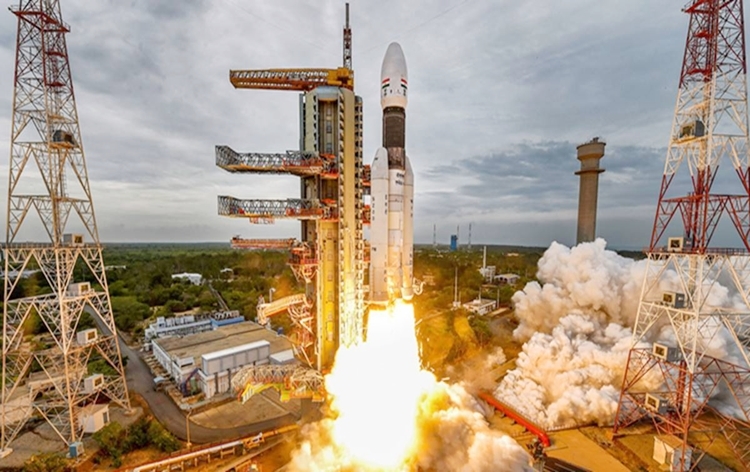
India’s Third Moon Mission: Chandrayaan-3 Begins its Journey to the Moon
India’s space agency, the Indian Space Research Organisation (ISRO), has successfully launched Chandrayaan-3, its third mission to the moon. Building upon the achievements of its predecessors, Chandrayaan-1 and Chandrayaan-2, this new mission aims to advance India’s exploration of the moon and deepen our understanding of our celestial neighbor.
Background and Objectives:
Chandrayaan-3 follows in the footsteps of previous Indian lunar missions, each contributing to India’s scientific and technological progress in space exploration. Chandrayaan-1, launched in 2008, made significant discoveries by detecting water molecules on the moon’s surface. Chandrayaan-2, launched in 2019, had the ambitious goal of landing a rover on the moon. Although the lander faced communication issues during descent, the orbiter continues to function and provide valuable data. With Chandrayaan-3, ISRO is determined to achieve a successful soft landing and further enhance India’s lunar exploration capabilities.
Launch and Payload:
In an awe-inspiring moment at the Satish Dhawan Space Centre in Sriharikota, Chandrayaan-3 lifted off into space aboard the Geosynchronous Satellite Launch Vehicle Mark III (GSLV Mk III) rocket. The launch was met with excitement from the global scientific community and space enthusiasts. The GSLV Mk III, known for its reliability and capacity, carried the Chandrayaan-3 spacecraft, which consists of an orbiter, lander, and rover.
The orbiter, a crucial component of the mission, will continue the work started by Chandrayaan-2. It will capture high-resolution images, study the moon’s topography, map the distribution of minerals, and conduct further research on the moon’s thin atmosphere.
The lander, equipped with advanced navigation and guidance systems, is designed to make a gentle landing on the moon’s surface. Once deployed, it will serve as a base for the rover and carry out detailed studies of the moon’s soil composition, temperature variations, and other scientific experiments.
The rover, a robotic explorer, will play a vital role in the mission. It is equipped with instruments and tools to analyze the lunar surface and collect crucial data. The rover’s mobility will allow it to traverse the moon’s terrain, gather samples, and conduct experiments, paving the way for future human missions to the moon.
Scientific Significance and Expected Outcomes:
Chandrayaan-3 holds great scientific significance, with several objectives aimed at expanding our knowledge of the moon. The mission aims to analyze the moon’s geological features, including the presence of water ice and potential resources that could be utilized for future lunar missions. By studying the moon’s atmosphere and its interaction with solar winds, scientists hope to gain insights into similar phenomena occurring on other celestial bodies in our solar system.
The mission also focuses on understanding the moon’s ancient geological history, shedding light on its formation and evolution. By analyzing samples and conducting experiments on the lunar surface, Chandrayaan-3 will contribute to our understanding of planetary geology and enhance our knowledge of the early solar system.
Collaborative Efforts:
ISRO recognizes the importance of international collaboration in space exploration. Therefore, Chandrayaan-3 will carry instruments developed by several international partners, fostering global cooperation in scientific endeavors. Collaborative efforts allow for the sharing of expertise, resources, and data, ultimately benefiting humanity’s collective understanding of the universe.
Future Implications:
The successful completion of Chandrayaan-3 will enhance India’s reputation as a leading player in space exploration and inspire future generations to pursue careers in science and technology. It will also pave the way for future lunar missions, including crewed missions, marking a significant milestone in India’s space program.
Chandrayaan-3 represents a bold leap forward in India’s lunar exploration journey. By building upon the achievements of previous missions and incorporating advanced technologies, ISRO aims to achieve a soft landing and gather valuable data from the lunar surface. The mission’s scientific objectives, international collaborations, and potential implications for future space exploration make Chandrayaan-3 an exciting endeavor that captures the imagination and curiosity of people worldwide. As the mission progresses, the world eagerly awaits the discoveries and breakthroughs that lie ahead, expanding our understanding of the moon and unlocking the secrets of the cosmos.