Swiggy Instamart Appoints Nandita Sinha as Chief Executive Officer
Instamart has named Nandita Sinha as its Chief Executive Officer, effective August 3, 20 26. Sinha will replace Amitesh Jha who steered the ultra-fast delivery platform through its rapid growth and margin enhancement phase. Coming with over two…
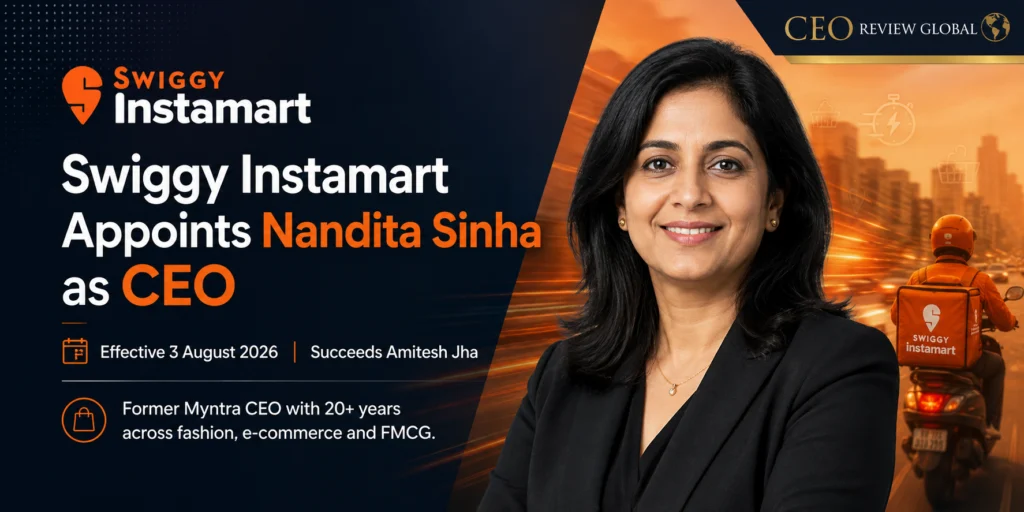
Instamart has named Nandita Sinha as its Chief Executive Officer, effective August 3, 20 26. Sinha will replace Amitesh Jha who steered the ultra-fast delivery platform through its rapid growth and margin enhancement phase.
Coming with over two decades of experience in fashion, ecommerce and fast moving consumer goods (FMCG), Sinha was previously heading Myntra as CEO. She has also served in leadership positions at Flipkart, Britannia and Hindustan Unilever. Sinha will lead Instamart’s growth story in the coming years and will own its customer strategy and operations.
Instamart said that Sinha’s consumer internet knowhow, operational excellence and focus on customer delight will enable it to strengthen its market position.
Quick commerce enters its hardest phase
Instamart has appointed Nandita Sinha as its Chief Executive Officer from August 3, 20 26. She will succeed Amitesh Jha who led the ultra-fast delivery platform during its hyper growth and margin expansion journey.
With more than 20 years of experience in fashion, ecommerce and fast moving consumer goods (FMCG) sectors, Sinha was earlier leading Myntra as CEO. She has also been a part of the leadership teams at Flipkart, Britannia and Hindustan Unilever. Sinha will drive Instamart’s growth trajectory in the years to come and will own its customer strategy as well as operations.
Instamart said that Sinha’s experience in consumer internet, operational excellence and her customer delight approach will help it further strengthen its position in the market.
Why Sinha fits the brief
Her experiences align with both sides of that dilemma. Hindustan Unilever and Britannia taught her the basics of consumer goods, such as brand equity, distribution and economics of the general trade. Flipkart and Myntra put her at the heart of India’s ecommerce revolution, where she focused on acquisition and retention of customers, and built platforms that serviced millions of customers.
Running Myntra taught her how to take merchandising decisions and make technology and logistics collaborate on a daily basis. Instamart poses the same challenge but at greater speed, with deliveries clocked in minutes instead of days.
The move continues a trend seen in Indian consumer internet where leaders with experience in multinational consumer goods companies have moved into platform companies, carrying category expertise.
Quick facts
- Role: Chief Executive Officer, Instamart
- Effective: 3 August 2026
- Succeeds: Amitesh Jha
- Previously: Chief Executive Officer, Myntra
- Earlier roles: Flipkart, Britannia, Hindustan Unilever
- Experience: More than 20 years
- Parent: Swiggy
Where Instamart sits inside Swiggy
Swiggy operates a consumer business that cuts across food delivery, eating out and, more recently, a fast-growing retail business. All three leverage the same customer relationship and, to some extent, the same delivery infrastructure. That’s the scale moat the group is trying to monetize.
Instamart is shouldering an outsized share of growth expectations from the group because grocery orders are inherently more frequent than restaurant orders. Frequency determines LTV, which determines how much the platform can pay towards acquisition.
What to watch next
Amitesh Jha is passing on the baton to Sinha with the business in a materially better shape. Jha grew the city and store footprint while shrinking losses. That’s a combination that category leaders have found tough and it should allow his successor to focus on growth rather than cleaning up. Sinha’s focus will likely be on deepening the assortment beyond staples grocery, improving customer retention and order frequency, and increasing the number of stores that are in positive contribution. Expanding into general merchandise, beauty and electronics will help with average order value but makes stock-keeping more complex within these small stores. Expansion into small and medium cities presents a real opportunity for growth. But the unit economics don’t automatically follow from what works in metros due to differences in density. Look at how quickly the network expands outside top 6 cities, and if contribution margin improves alongside sales or only after a certain level of scale is reached.
Isha Sharma
Editor, Executive Appointments · CEO Review Magazine
Isha Sharma covers executive appointments and leadership changes for CEO Review Magazine, reporting on new CEO, CXO and board-level moves at Indian and global companies and what they mean for the businesses involved.