Digital Marketing Trends You Should Pay Attention to in 2026
Three years ago, this list would have told you to optimize for voice search and experiment with chatbots. Both predictions came true — just not in the way anyone expected. Voice search never became the channel marketers…
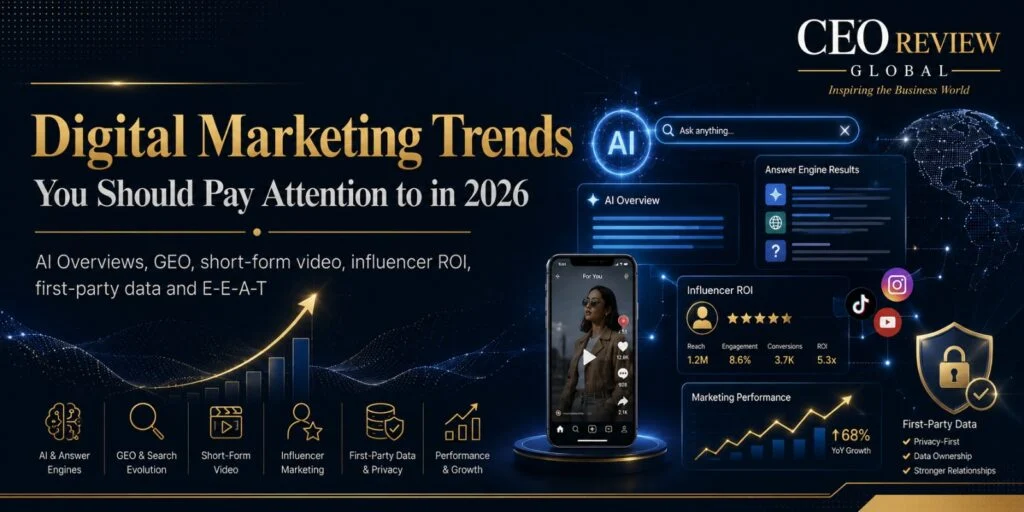
Three years ago, this list would have told you to optimize for voice search and experiment with chatbots. Both predictions came true — just not in the way anyone expected. Voice search never became the channel marketers braced for, but conversational AI did something bigger: it became the front door to the internet itself.
In 2026, half of all Google searches now trigger an AI Overview, and a majority of browser-based searches end without a single click to an outside website, according to industry tracking from Search Engine Land and BrightEdge. For business leaders, that single shift changes almost everything downstream — how content gets written, how budgets get allocated, and how “visibility” gets measured. Here’s what actually matters this year, and what to do about it.
1. AI Overviews Have Made Zero-Click Search the Default
Google’s AI Overviews now appear on roughly half of US search queries and reach an estimated two billion monthly users worldwide. When an AI Overview appears, click-through to the underlying websites drops sharply — some studies put the decline at 60% or more for the affected queries.
This doesn’t mean SEO is dead. It means the goalpost moved from “rank in the top 10” to “get cited inside the answer.” Pages that are clearly structured, directly answer a specific question, and cite real data are the ones AI systems pull from — a pattern several 2026 studies now describe as the AI Overview visitor being worth several times more than a traditional organic visitor, because by the time someone clicks through from an AI summary, they’ve already done most of their research.
What to do: Audit your highest-intent pages for direct, quotable answers near the top of the content, add FAQ sections that mirror real search questions, and start tracking brand mentions inside AI answers — not just organic rankings — as a core KPI.
2. Answer Engine Optimization (AEO) and Generative Engine Optimization (GEO) Are Now Separate Disciplines
Traditional SEO optimized for a ranked list of blue links. AEO and GEO optimize for something different: being the source an AI model chooses to cite or summarize, whether that’s Google’s AI Mode, ChatGPT Search, Perplexity, or Microsoft Copilot. Google’s own search discovery is still sending more AI-influenced traffic than every standalone chatbot combined, which means this isn’t a “ditch Google for ChatGPT” story — it’s a “structure everything for machine readability” story.
What to do: Build content around clear, well-sourced claims; use structured data (FAQ, HowTo, Article schema); and treat topical depth as a moat. Programmatic, templated pages — the kind that swap a city or country name into an identical article — are exactly what’s losing ground, because generative engines can spot boilerplate faster than human readers can.
3. Short-Form Video Still Wins, But Only With Real Substance Behind It
Short-form video remains the highest-ROI content format for marketers in 2026, according to HubSpot’s State of Marketing research, ahead of long-form video and live streaming. But the bar has risen: AI-generated video and imagery are now so common on platforms like TikTok — over a billion videos there already carry AI-generated labels — that raw production value alone no longer differentiates a brand. What’s cutting through is short-form content built around genuine expertise, a real product demo, or a specific, useful answer, rather than trend-chasing for its own sake.
What to do: Repurpose your best long-form or interview content into short-form clips rather than treating short video as a separate content stream — this is also where a magazine or publisher’s existing interview archive becomes a real advantage.
4. Influencer Marketing Has Matured Into a Measured, ROI-Driven Channel
The influencer marketing industry has grown into a market worth well over $30 billion globally, and it’s no longer a brand-awareness experiment — it’s a performance channel with real benchmarks. The clearest shift in 2026 is toward micro- and nano-creators: they now account for a growing share of total influencer spend because they consistently out-engage larger accounts at a fraction of the cost, and platforms like TikTok Shop have made creator content directly shoppable rather than just inspirational.
What to do: If your influencer strategy still centers on a handful of large-name partnerships, test reallocating part of that budget toward a wider bench of smaller, niche-relevant creators and track sales attribution, not just reach.
5. AI Is Now Core Infrastructure, Not an Experiment
The overwhelming majority of marketers report using AI tools daily in 2026 — for content drafting, audience segmentation, campaign optimization, and increasingly, media production. The conversation has shifted from “should we use AI” to “is our AI workflow actually producing measurable results, or just more content.” Marketing leaders surveyed this year consistently flag a readiness gap: budgets for AI are rising faster than teams’ ability to use it well.
What to do: Treat AI as a production accelerant, not a strategy substitute. The brands still ranking and getting cited in AI answers are the ones combining AI-assisted production with real human editorial judgment and fact-checking — not the ones publishing unreviewed AI output at volume.
6. First-Party Data and Privacy-First Marketing Are No Longer Optional
With third-party cookie restrictions now largely in effect across major browsers and continued regulatory pressure globally, brands that built durable first-party data relationships — email lists, loyalty programs, direct customer research — are the ones with reliable targeting and measurement in 2026. Everyone else is increasingly flying blind on attribution.
What to do: Prioritize owned channels (email, SMS, loyalty, community) as the foundation of your data strategy, and make sure your analytics stack accounts for AI-referred traffic, which behaves differently from traditional organic visitors and can otherwise get miscounted or missed entirely.
7. E-E-A-T Has Become the Real Ranking Currency
Google’s 2026 core updates reinforced a consistent theme: sites with clear first-hand expertise, named authors, and original reporting are outperforming high-volume, templated content — even when the templated content is technically well-optimized. Google has been explicit that the issue was never AI authorship itself, but a lack of genuine expertise and quality control, whichever tool produced the words.
What to do: Invest in bylined, credentialed content over anonymous or thin posts. An interview with a named executive, backed by direct quotes and specific detail, will consistently outperform a generic “trends to watch” roundup with no original reporting — a lesson publishers in particular can’t afford to ignore.
8. Discovery Is Fragmenting Across Platforms — “Search Everywhere” Is the New Baseline
Consumers no longer start every purchase journey on Google. Product research now happens inside TikTok, YouTube, Instagram, and AI chat interfaces just as often as in a traditional search bar, and a majority of social users say they research products through creator content before buying. For B2B specifically, buyers increasingly use generative AI tools during the research phase before ever contacting a vendor.
What to do: Map where your specific audience actually researches and buys — not just where competitors post — and build a consistent presence across those 2–3 platforms rather than spreading thin across all of them.
The Bottom Line for Business Leaders
The common thread across every trend above is the same: volume and keyword-matching are no longer enough. The channels rewarding brands in 2026 — AI answer citations, short-form video, influencer partnerships, organic search — all reward the same underlying thing: real expertise, clearly demonstrated, consistently published. For leadership teams, that’s a resourcing question as much as a marketing one: it’s less about buying more tools and more about backing the people and processes that produce genuinely original, well-sourced content.
FAQ
What is the biggest digital marketing trend in 2026?
The shift toward AI-powered, zero-click search is the trend with the widest impact — roughly half of Google searches now surface an AI Overview, changing how content needs to be structured to earn visibility.
Is SEO still worth investing in for 2026?
Yes, but the discipline has broadened. Traditional keyword-focused SEO now sits alongside Answer Engine Optimization (AEO) and Generative Engine Optimization (GEO), which focus on getting cited inside AI-generated answers rather than just ranking in a list of links.
Should brands still invest in influencer marketing?
Influencer marketing remains one of the highest-ROI channels available, but 2026 data favors a portfolio of micro- and nano-creators over a small number of expensive, large-name partnerships.
Three years ago, this list would have told you to optimize for voice search and experiment with chatbots. Both predictions came true — just not in the way anyone expected. Voice search never became the channel marketers braced for, but conversational AI did something bigger: it became the front door to the internet itself.
In 2026, half of all Google searches now trigger an AI Overview, and a majority of browser-based searches end without a single click to an outside website, according to industry tracking from Search Engine Land and BrightEdge. For business leaders, that single shift changes almost everything downstream — how content gets written, how budgets get allocated, and how “visibility” gets measured. Here’s what actually matters this year, and what to do about it.
1. AI Overviews Have Made Zero-Click Search the Default
Google’s AI Overviews now appear on roughly half of US search queries and reach an estimated two billion monthly users worldwide. When an AI Overview appears, click-through to the underlying websites drops sharply — some studies put the decline at 60% or more for the affected queries.
This doesn’t mean SEO is dead. It means the goalpost moved from “rank in the top 10” to “get cited inside the answer.” Pages that are clearly structured, directly answer a specific question, and cite real data are the ones AI systems pull from — a pattern several 2026 studies now describe as the AI Overview visitor being worth several times more than a traditional organic visitor, because by the time someone clicks through from an AI summary, they’ve already done most of their research.
What to do: Audit your highest-intent pages for direct, quotable answers near the top of the content, add FAQ sections that mirror real search questions, and start tracking brand mentions inside AI answers — not just organic rankings — as a core KPI.
2. Answer Engine Optimization (AEO) and Generative Engine Optimization (GEO) Are Now Separate Disciplines
Traditional SEO optimized for a ranked list of blue links. AEO and GEO optimize for something different: being the source an AI model chooses to cite or summarize, whether that’s Google’s AI Mode, ChatGPT Search, Perplexity, or Microsoft Copilot. Google’s own search discovery is still sending more AI-influenced traffic than every standalone chatbot combined, which means this isn’t a “ditch Google for ChatGPT” story — it’s a “structure everything for machine readability” story.
What to do: Build content around clear, well-sourced claims; use structured data (FAQ, HowTo, Article schema); and treat topical depth as a moat. Programmatic, templated pages — the kind that swap a city or country name into an identical article — are exactly what’s losing ground, because generative engines can spot boilerplate faster than human readers can.
3. Short-Form Video Still Wins, But Only With Real Substance Behind It
Short-form video remains the highest-ROI content format for marketers in 2026, according to HubSpot’s State of Marketing research, ahead of long-form video and live streaming. But the bar has risen: AI-generated video and imagery are now so common on platforms like TikTok — over a billion videos there already carry AI-generated labels — that raw production value alone no longer differentiates a brand. What’s cutting through is short-form content built around genuine expertise, a real product demo, or a specific, useful answer, rather than trend-chasing for its own sake.
What to do: Repurpose your best long-form or interview content into short-form clips rather than treating short video as a separate content stream — this is also where a magazine or publisher’s existing interview archive becomes a real advantage.
4. Influencer Marketing Has Matured Into a Measured, ROI-Driven Channel
The influencer marketing industry has grown into a market worth well over $30 billion globally, and it’s no longer a brand-awareness experiment — it’s a performance channel with real benchmarks. The clearest shift in 2026 is toward micro- and nano-creators: they now account for a growing share of total influencer spend because they consistently out-engage larger accounts at a fraction of the cost, and platforms like TikTok Shop have made creator content directly shoppable rather than just inspirational.
What to do: If your influencer strategy still centers on a handful of large-name partnerships, test reallocating part of that budget toward a wider bench of smaller, niche-relevant creators and track sales attribution, not just reach.
5. AI Is Now Core Infrastructure, Not an Experiment
The overwhelming majority of marketers report using AI tools daily in 2026 — for content drafting, audience segmentation, campaign optimization, and increasingly, media production. The conversation has shifted from “should we use AI” to “is our AI workflow actually producing measurable results, or just more content.” Marketing leaders surveyed this year consistently flag a readiness gap: budgets for AI are rising faster than teams’ ability to use it well.
What to do: Treat AI as a production accelerant, not a strategy substitute. The brands still ranking and getting cited in AI answers are the ones combining AI-assisted production with real human editorial judgment and fact-checking — not the ones publishing unreviewed AI output at volume.
6. First-Party Data and Privacy-First Marketing Are No Longer Optional
With third-party cookie restrictions now largely in effect across major browsers and continued regulatory pressure globally, brands that built durable first-party data relationships — email lists, loyalty programs, direct customer research — are the ones with reliable targeting and measurement in 2026. Everyone else is increasingly flying blind on attribution.
What to do: Prioritize owned channels (email, SMS, loyalty, community) as the foundation of your data strategy, and make sure your analytics stack accounts for AI-referred traffic, which behaves differently from traditional organic visitors and can otherwise get miscounted or missed entirely.
7. E-E-A-T Has Become the Real Ranking Currency
Google’s 2026 core updates reinforced a consistent theme: sites with clear first-hand expertise, named authors, and original reporting are outperforming high-volume, templated content — even when the templated content is technically well-optimized. Google has been explicit that the issue was never AI authorship itself, but a lack of genuine expertise and quality control, whichever tool produced the words.
What to do: Invest in bylined, credentialed content over anonymous or thin posts. An interview with a named executive, backed by direct quotes and specific detail, will consistently outperform a generic “trends to watch” roundup with no original reporting — a lesson publishers in particular can’t afford to ignore.
8. Discovery Is Fragmenting Across Platforms — “Search Everywhere” Is the New Baseline
Consumers no longer start every purchase journey on Google. Product research now happens inside TikTok, YouTube, Instagram, and AI chat interfaces just as often as in a traditional search bar, and a majority of social users say they research products through creator content before buying. For B2B specifically, buyers increasingly use generative AI tools during the research phase before ever contacting a vendor.
What to do: Map where your specific audience actually researches and buys — not just where competitors post — and build a consistent presence across those 2–3 platforms rather than spreading thin across all of them.
The Bottom Line for Business Leaders
The common thread across every trend above is the same: volume and keyword-matching are no longer enough. The channels rewarding brands in 2026 — AI answer citations, short-form video, influencer partnerships, organic search — all reward the same underlying thing: real expertise, clearly demonstrated, consistently published. For leadership teams, that’s a resourcing question as much as a marketing one: it’s less about buying more tools and more about backing the people and processes that produce genuinely original, well-sourced content.
FAQ
What is the biggest digital marketing trend in 2026?
The shift toward AI-powered, zero-click search is the trend with the widest impact — roughly half of Google searches now surface an AI Overview, changing how content needs to be structured to earn visibility.
Is SEO still worth investing in for 2026?
Yes, but the discipline has broadened. Traditional keyword-focused SEO now sits alongside Answer Engine Optimization (AEO) and Generative Engine Optimization (GEO), which focus on getting cited inside AI-generated answers rather than just ranking in a list of links.
Should brands still invest in influencer marketing?
Influencer marketing remains one of the highest-ROI channels available, but 2026 data favors a portfolio of micro- and nano-creators over a small number of expensive, large-name partnerships.

Chirag Thakur
Editor, Business News · CEO Review Magazine
Chirag Thakur covers business news for CEO Review Magazine, along with markets, technology and industry explainers and the magazine's Top 10 rankings of companies and leaders.